











Rail surveying has always operated within tight margins. Possessions are finite, safety requirements are non-negotiable, and the consequences of incomplete or inaccurate data can be significant. But over the past decade, those margins have narrowed considerably. For Severn Partnership, part of the Munnelly Group, adapting to that reality has meant rethinking not just the tools they use, but the entire approach to how survey work is planned, executed, and delivered.
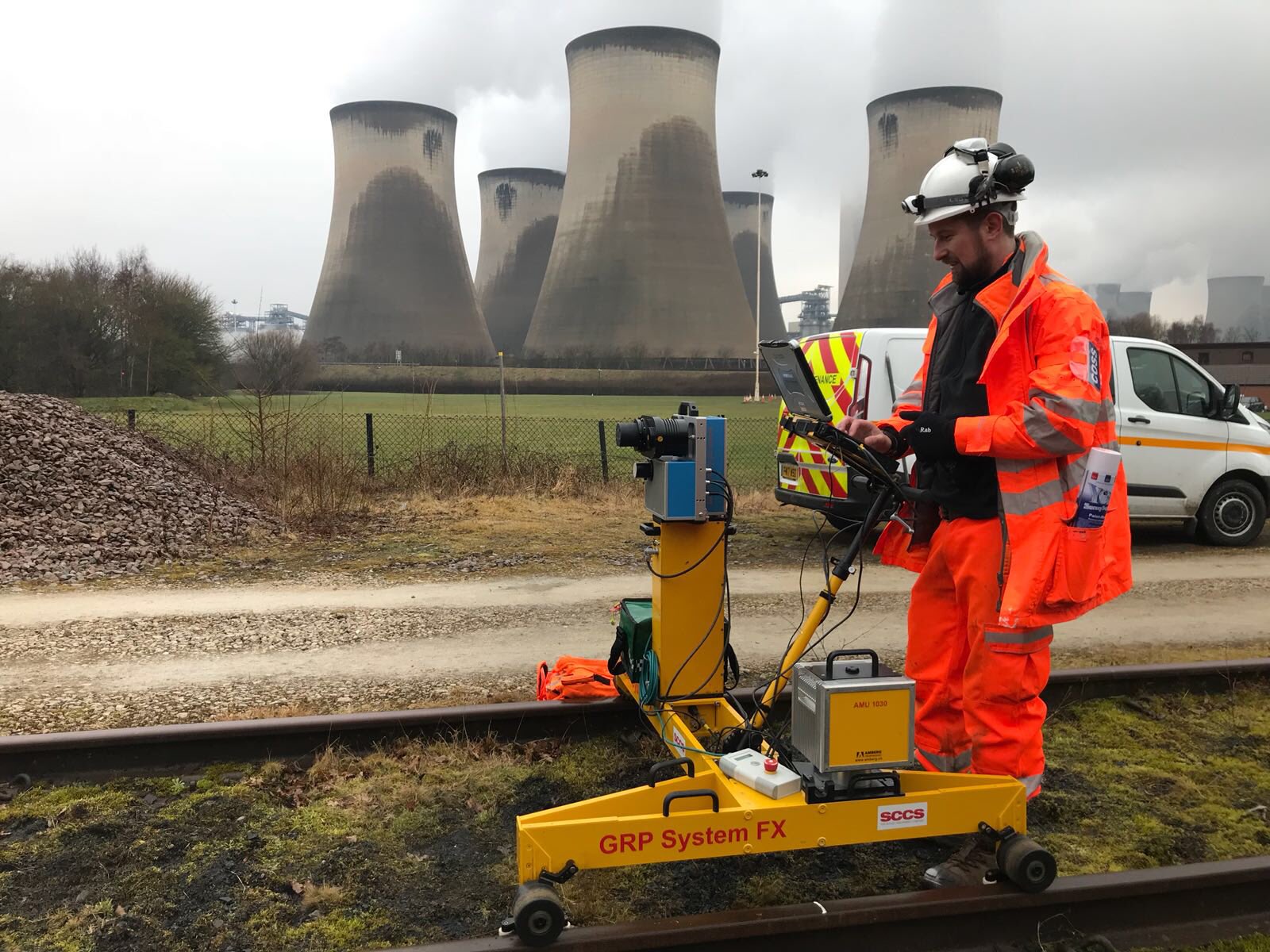
At the centre of that shift is a combination of Leica Geosystems and Amberg technology, the Leica Pegasus Two Ultimate mobile mapping system, the Stream Up ground penetrating radar (GPR), and the Amberg IMS5000 rail measurement system, deployed together to meet the demands of one of the UK’s most operationally complex environments.
A shrinking window and a growing challenge
Track access time in the UK has been on a steady decline. Where Severn Partnership once worked in daylight hours alongside running trains, increasing safety requirements shifted the majority of rail survey work to nights, and now predominantly to weekend possessions. In practical terms, that has meant the available working window has roughly halved from close to forty hours per week to around twenty hours at best.
“We’ve nearly lost half the time we used to have,” explains Michael Beevers, Operations Director at Severn Partnership. “Which is where the technology comes in.”
The scale of the difference that Leica Geosystems and Amberg technology has made is measurable in straightforward terms. A task that previously required up to eight personnel on site to survey one to two kilometres of track can now be completed by a two-person team covering five kilometres within a three-hour possession. That is not an incremental improvement; it is a fundamental change in what is operationally possible.
Technology in the field
Severn Partnership operates across a broad spectrum of rail activities, including high-output renewal surveys for Network Rail, platform reconstruction and electrification schemes, bridge scanning, gauging for track lowering and raising, and tunnelling. Each environment carries its own challenges, and the Leica Geosystems technology combination addresses them in different ways.
Mobile mapping: highways and rail in a single deployment
The Leica Pegasus Two Ultimate provides mobile mapping capability across both highways and rail. Mounted on road-rail vehicles in partnership with Aquarius Rail, the system allows continuous data capture, including 360-degree imagery, through environments where traditional survey methods would require extended site time or significant traffic management. A single-day deployment has, in one case, enabled Severn Partnership to collect data across approximately ten kilometres of track and twelve kilometres of highway simultaneously. Work that would previously have taken weeks.
“Being able to do that and then move the site work essentially into the office, that is so valuable,” says Michael. The point cloud data, combined with 360 imagery, allows office-based interrogation of site conditions long after the possession has closed. It also supports a collaborative approach with clients: collect the priority data, bank the wider capture, and process additional information only when it becomes relevant, which avoids costly return visits.
Ground-penetrating radar: a uniquely adapted solution
The Stream Up GPR, air-mounted on a Road Rail Vehicle (RRV) via a purpose-designed mechanical arm, addresses a specific challenge that standard hand-push systems cannot reliably solve. In ballasted track environments, loose stone makes physical contact between equipment and ground surface problematic, limiting the quality of data that conventional GPR methods can deliver. By hovering the Stream Up above the ballast, Severn Partnership overcomes that limitation entirely.
Critically, this configuration is one that Severn developed independently. Working in partnership with Quattro Plant, Severn Partnership designed and fabricated the RRV mounting from scratch, a piece of R&D that, to Michaels’ knowledge, remains unique in the UK rail survey sector. The practical result? A 200-metre section of track that once required manual handling across difficult terrain can now be surveyed in ten to fifteen minutes, with higher quality data and fewer personnel on ballast.
On the Core Valley Lines in South Wales, this approach has supported a programme of culvert identification, locating buried infrastructure that, in some cases, has no documented entrance or exit point. As a by-product of that primary objective, the system simultaneously captures additional subsurface data on services, bridge decks and voids, supporting asset management decisions well beyond the original survey scope.
Rail measurement: consolidating the survey stack
The Amberg system brings a further layer of capability, consolidating several previously discrete rail survey processes into a single deployment. Beyond standard rail string extraction and cess feature capture, it delivers gauging data for structural clearance assessments. A profiling function now generates worst-case clearance over a continuous five-metre rolling section, which is a significant development in tunnel survey, where a single missed reading under traditional methods could create gaps in safety-critical clearance data.
Making safety a measurable outcome
Throughout Severn Partnership’s adoption of this technology stack, safety improvements have been as significant as the productivity gains. Michael is direct on the point: “Boots off ballast is the term we use. The fewer people we can put in possible harm’s way, the better.”
Reducing site teams from eight personnel to two has a compounding effect on risk: fewer people travelling to the site on night shifts, fewer individuals exposed to live rail environments, and less manual handling across uneven ballast. For a sector where safety compliance is both a regulatory obligation and a commercial differentiator, that reduction in exposure carries considerable weight.
A technology-forward future
Severn Partnership is in the process of formalising a dedicated rail department, a structural change that reflects both the growth of that workstream and the company’s confidence in its technical positioning.
The Severn team is currently considering adding the IDS Chaser XR to their toolkit for smaller-scale track GPR, and the IDS SafeRailSystem (SRS) monitoring system, technology Michael believes is gaining traction in the UK market. A transition from the Pegasus Two Ultimate to a new-generation mobile mapping system like the Leica Pegasus TRK is also under consideration as the company plans for growth in the decade ahead.
For Severn Partnership, the combination of Leica Geosystems and Amberg technology, along with its own unique engineering ingenuity, has done more than improve survey efficiency. It has repositioned what a specialist team is capable of delivering and redefined what clients working in the UK’s rail infrastructure are starting to expect.
To find out more about Severn Partnership, visit www.severnpartnership.com. To connect with Michael Beevers, Operations Director, find him on LinkedIn.
Leica Geosystems, part of Hexagon, creates complete solutions for professionals across the survey, construction, reality capture, and geospatial industries. Learn more at leica-geosystems.com/en-gb.