













When Ash Johnson joined SPL Powerlines UK and Ireland as Head of Surveying four and a half years ago, the company was firmly focused on electrification installation and construction. Today, that picture looks quite different. A shifting funding landscape and a growing demand for cost-effective rail data have reshaped what the SPL Powerlines survey division does and how it does it. At the centre of that evolution sits the Leica Pegasus TRK.
Ash manages a team of ten surveyors working across the UK and Ireland. As part of a strategic push to diversify, SPL Powerlines identified a gap in the market for cost-effective mobile mapping services in rail maintenance and renewals. “We wanted to branch out into another corner of the market,” he explained, and that opportunity, it turned out, had been there all along.
The Transition to Mobile Mapping Technology
Before adopting mobile mapping, SPL Powerlines surveys relied on total stations, Global Navigation Satellite System (GNSS) and manual gauges. A track trolley system was also in use, but even that fell short of what clients increasingly required. The core problem was simple: short access windows on the railway, combined with constrained budgets, meant teams could rarely capture enough data within the time allocated and funds available.
In the past, a typical weekend shift might cover no more than three kilometres using traditional means. Access windows are scarce and some sites cannot be revisited for six to twelve weeks or more, which means every hour on the track had to be as productive as possible. That pressure, along with the responsibility of managing large site teams for extended periods, made a strong case for a fundamentally different approach.
A Shake-Up for Productivity
The introduction of the Leica Pegasus TRK shifted the equation for Ash and his team dramatically. Where three kilometres previously represented a solid night’s work, the TRK made even 20–30 kilometres a realistic target in a single shift, provided that access was available. What had previously required multiple weekends could now be captured in one go.
The model also changed how Ash manages his team; rather than cycling surveyors through weeks of continuous site work, he now runs a rhythm of weekend capture and weekday processing. The same ten-person team is doing more and developing broader skills in the process. “It gives them a broader experience and allows me to train them in a way I wasn’t really able to before,” he said. “It also smooths the peaks and troughs of workflow, which is better for everyone.”
The shift in productivity has also helped stabilise headcount. The new model means the same team moves fluidly between fieldwork and office processing, making it easier to retain people and manage demand over time.
Fewer People, Less Risk, Better Data
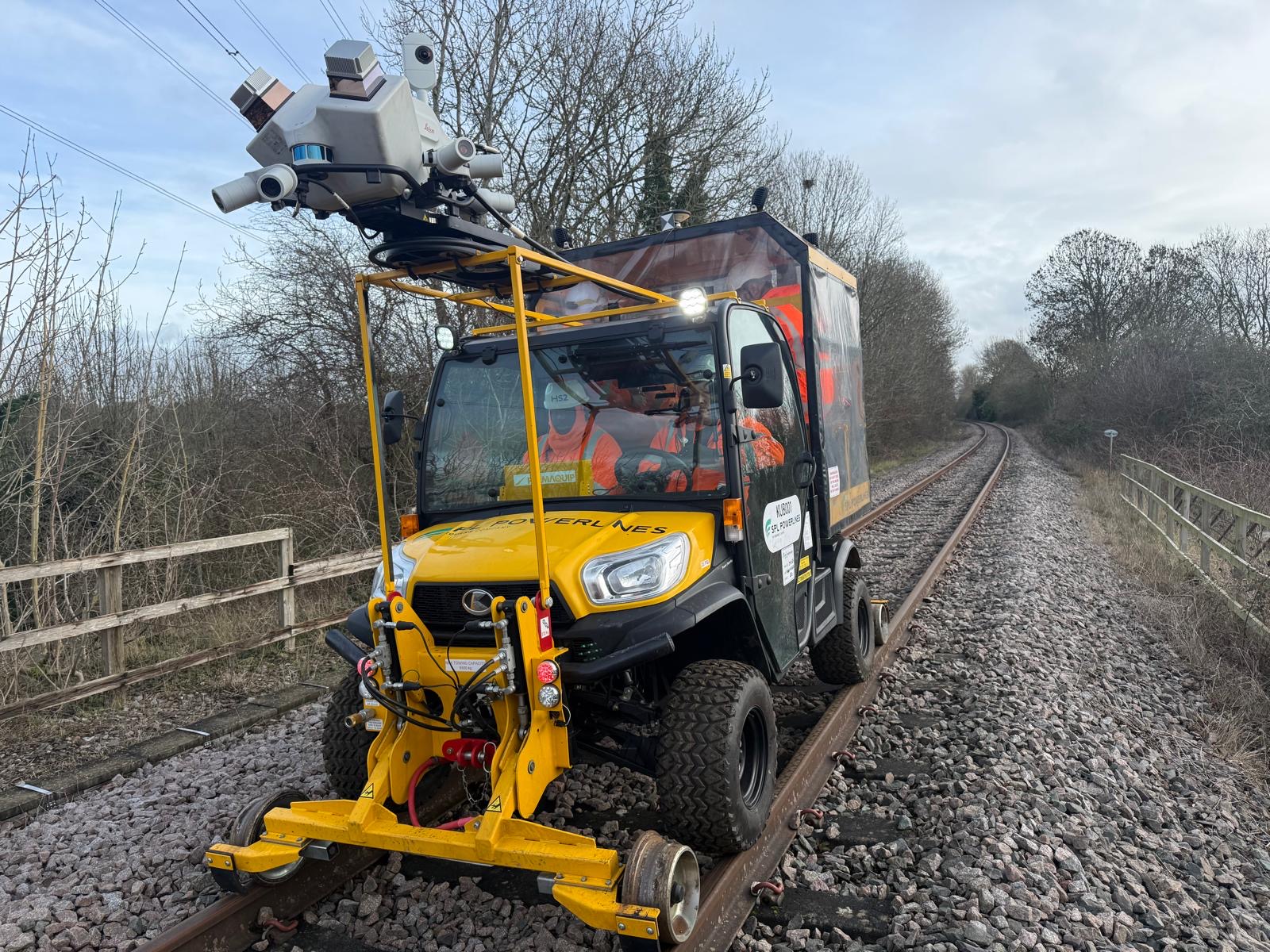
The safety case for mobile mapping is just as compelling as the productivity gains. SPL Powerlines deploys the Leica Pegasus TRK, typically using their own Kubota RTV 900 road rail vehicle, but the system is flexible enough to be deployed on a multitude of other road rail vehicles and even modified inspection locomotives. This means a single four-person team can survey more miles of track, where previously a significant amount of staff would have been required over multiple weekends. Shorter, less physically demanding shifts reduce fatigue risk significantly; capturing a full site in two to three hours is a very different proposition from a gruelling twelve-hour night.
Beyond reduced exposure time, the nature of the work has changed fundamentally. Surveyors who previously had to navigate embankments and vegetation to capture data manually, now operate from within the vehicle, monitoring incoming data on a tablet. “They’re not as exposed to the lineside hazards that are present all over the railway,” Ash said. “Less fatigue means fewer mistakes, even if it’s not safety-related, even just with the data capture.”
Opening the Door for New Clients
One of the more significant commercial shifts didn’t come from SPL Powerlines own strategy, but from a change in the wider market. A train-mounted survey system that had long served as the industry baseline for large-scale data capture exited the UK market, leaving organisations across the rail sector without their usual method for baseline surveys. For SPL Powerlines, it opened a door.
“What we’re trying to achieve is offering mass data capture to clients who wouldn’t normally have had the budget in the past,” Ash explained.
The key lies in understanding the level of accuracy a client actually requires. In overhead line equipment (OLE) surveys, for example, relative accuracy is often more critical than absolute positional accuracy. It is the spatial relationship between rails, wires and trackside structures that ultimately informs maintenance strategies and design decisions.
“At the outset of any project enquiry, we take the time to fully understand the client’s requirements and budget, ensuring we propose the most appropriate solution for their needs,” explains Ash. This approach enables SPL Powerlines to deliver genuinely cost-effective outcomes without the risk of over-specification.
Crossing the Irish Sea
The flexibility of the Leica Pegasus TRK has also been central to SPL Powerlines recent expansion into Ireland. Because the track gauge in the majority of Ireland differs from the UK standard, SPL Powerlines’ road-rail vehicle cannot be used there. The Leica Pegasus TRK, however, is platform-agnostic; it has been deployed on road vehicles, boats and trains depending on what the project demands. When work in Ireland required it, the unit simply travelled by ferry and was mounted onto locally available equipment.
SPL Powerlines has since surveyed the Belfast to the border route for Translink in support of proposed future electrification, delivering outline design-quality data within a budget that a traditional approach could not have matched. “The fact that we can just take the TRK over on the ferry and start work using the kit that’s already there is massive for us,” Ash said. “If it was tied to a specific vehicle, we’d struggle.”
The Purchase to ROI Story
When Ash first developed the business case for the TRK, it was based on deliberately conservative assumptions around monthly usage. In practice, uptake and demand for the service has significantly exceeded expectations. This stronger-than-anticipated performance has also enabled SPL Powerlines not only to achieve a return on the initial investment, but also to reinvest in additional capabilities, bolt-on features and software enhancements that continue to strengthen their overall offering.
Building a Business for What Comes Next
What sets SPL Powerlines apart in this space, Ash argues, is not just the technology; it is the depth of expertise surrounding it. Unlike pure survey companies, SPL Powerlines has embedded designers, engineers and construction teams who understand how survey data translates into real-world outcomes. “We know the componentry, we know how to build and integrate multi-rail systems and how to keep it running,” he said. “So, we’re uniquely placed to give that data back to the client in the most efficient way possible.”
This integrated capability is increasingly acting as a commercial door-opener. Survey engagements frequently lead to follow-on conversations about construction or engineering work, giving SPL Powerlines a route into client relationships that might otherwise have taken years to build.
Looking ahead, SPL Powerlines is actively diversifying into energy and other sectors such as road and highways. The Leica Pegasus TRK will have a role to play there too, as part of a broader ecosystem that includes UAV, LiDAR and static laser scanning capabilities. “The fact that we’re innovating and developing new offerings means we’re staying relevant and we’re starting to see green shoots,” Ash said.
SPL Powerlines is looking forward to continually evolving the system in conjunction with Leica Geosystems. Integrating trials with the TRK and SRS GPR Array are producing very promising results which SPL Powerlines looks to develop on in the future.
About SPL Powerlines UK
SPL Powerlines UK is a specialist rail electrification and engineering company operating across the UK and Ireland. Connect withAsh Johnson on LinkedIn or visit powerlines-group.com/uk.
About the Leica Pegasus TRK
The Leica Pegasus TRK is a mobile mapping system designed for rail environments, combining LiDAR, photogrammetry and positioning technology for high-density asset capture in a single pass. Learn more at leica-geosystems.com or contact Matt Lock to find out more.